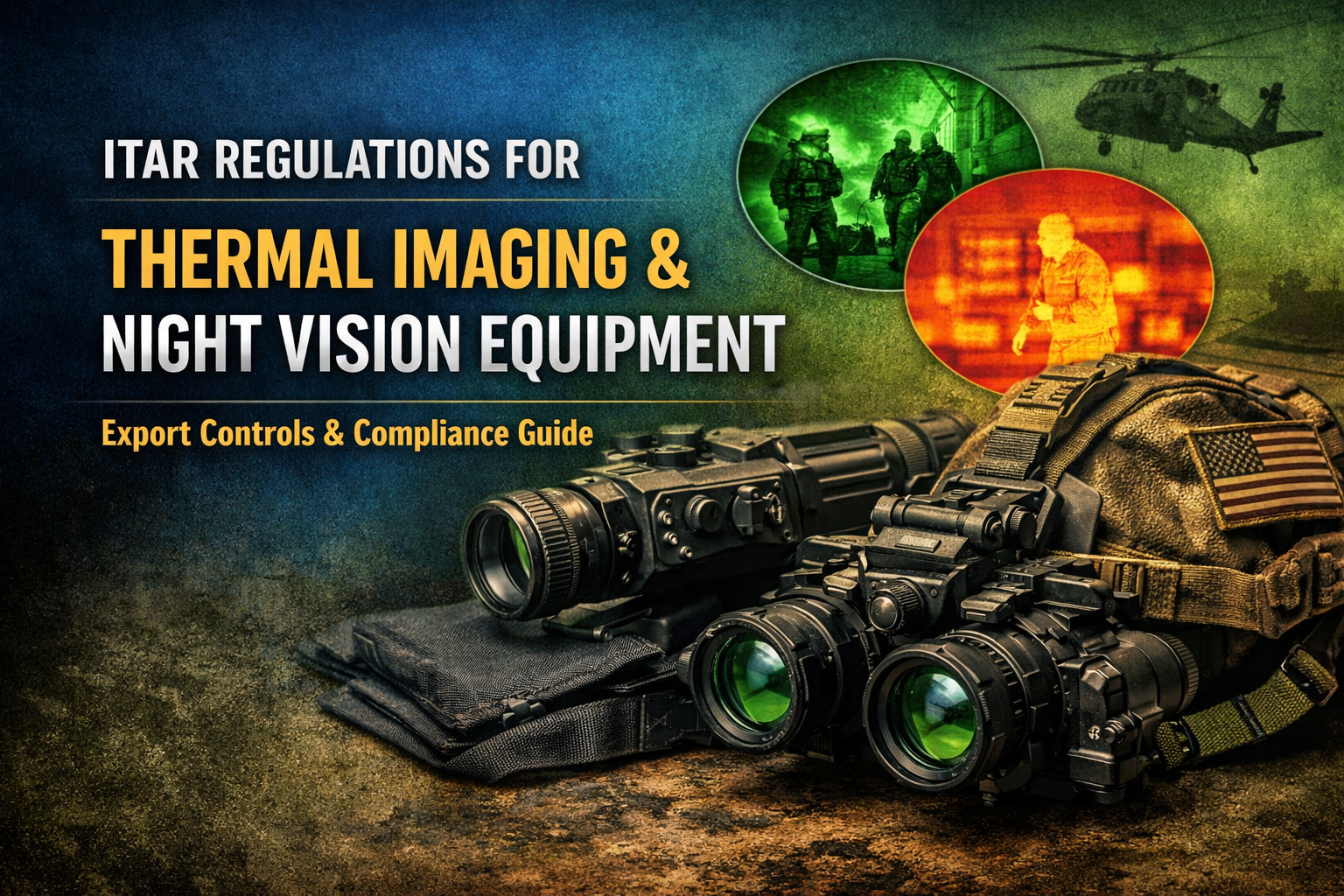

ITAR Regulations for Thermal Imaging and Night Vision Equipment
The International Traffic in Arms Regulations (ITAR) govern the export and transfer of certain defense-related articles, services, and technical data. For buyers and sellers of thermal imaging systems and night vision equipment, understanding how ITAR applies is essential to remain compliant with U.S. law.
Because these technologies provide significant tactical and surveillance advantages, many military-grade thermal imagers and night vision devices are subject to strict export controls—even when sold domestically or as surplus.
What Is ITAR?
ITAR is a U.S. government regulatory framework administered by the U.S. Department of State through the Directorate of Defense Trade Controls (DDTC). The DDTC is responsible for regulating defense trade and issuing export licenses for controlled items.
Official guidance and compliance resources are provided directly by the State Department via the DDTC:
https://www.pmddtc.state.gov/
The full legal text of ITAR is published in the Code of Federal Regulations (22 CFR Parts 120–130):
https://www.ecfr.gov/current/title-22/chapter-I/subchapter-M
Failure to comply with ITAR can result in:
- Significant civil penalties
- Criminal prosecution
- Debarment from future export activity
Why Thermal Imaging and Night Vision Are Regulated
Thermal imaging and night vision technologies are considered force-multiplying capabilities. These systems allow users to detect, identify, and track objects in low-light or no-light environments, making them critical to:
- Military operations
- Law enforcement aviation
- Border and perimeter security
- Aerial surveillance and reconnaissance
Because of their operational value, advanced systems—particularly those designed for military or aviation use—are often regulated as defense articles.
ITAR and Night Vision Equipment
Which Night Vision Devices Are Typically ITAR-Controlled?
Night vision systems are commonly subject to ITAR when they include:
- Generation III (Gen 3) image intensifier tubes
- Aviation-grade or autogated tubes
- High signal-to-noise ratios
- Extended detection ranges
- Weapon or aircraft integration
Importantly, used, surplus, or refurbished night vision equipment does not lose ITAR status simply due to age or resale.
Civilian vs ITAR-Controlled Night Vision
Some commercial night vision products—such as lower-performance or hunting-grade optics—may fall under the Export Administration Regulations (EAR) instead of ITAR.
EAR is administered by the U.S. Department of Commerce through the Bureau of Industry and Security (BIS):
https://www.bis.doc.gov/
However, export classification must always be verified before resale or transfer to any non-U.S. person.
ITAR and Thermal Imaging Systems
Are All Thermal Cameras ITAR-Controlled?
No. However, many military-grade and aviation-specific thermal imaging systems are.
Thermal imagers are more likely to be ITAR-controlled if they feature:
- Long-range detection capability
- Airborne or helicopter mounting
- Cooled MWIR or LWIR sensors
- Advanced image processing
- Target tracking or ISR functionality
Examples include airborne surveillance cameras, vehicle-mounted thermal sights, and integrated reconnaissance platforms.
Commercial thermal cameras designed for building inspection, firefighting, or industrial maintenance are often EAR-controlled—but confirmation is required.
What Counts as an “Export” Under ITAR
Under ITAR, an export is not limited to shipping equipment overseas.
According to the official ITAR export definition (22 CFR §120.17):
https://www.ecfr.gov/current/title-22/chapter-I/subchapter-M/part-120/section-120.17
An export may include:
- Shipping controlled equipment outside the U.S.
- Transferring possession to a foreign person
- Providing access to controlled technical data
- Allowing a foreign national to take possession of controlled equipment within the United States
As a result, domestic transactions can still raise ITAR concerns depending on the buyer and end use.
Who Can Purchase ITAR-Controlled Thermal or Night Vision Equipment?
Typically permitted purchasers include:
- U.S. government agencies
- U.S. law enforcement departments
- U.S. military contractors
- U.S. citizens and lawful permanent residents (with restrictions)
Common restrictions apply to:
- Foreign nationals
- Foreign companies
- Export or re-export without authorization
- Transfers outside the United States
Used and Surplus Equipment Is Still Controlled
A common misconception is that used, surplus, or decommissioned equipment is no longer subject to ITAR.
This is incorrect.
ITAR status is determined by:
- Original design intent
- Technical capability
- Military or defense application
Age, condition, or resale status do not remove export control requirements.
Compliance Responsibilities for Buyers and Sellers
Seller Responsibilities
- Clearly disclose export restrictions
- Screen buyers and end users
- Obtain end-use statements when required
- Avoid unauthorized international shipments
Buyer Responsibilities
- Understand possession vs export limitations
- Avoid transferring controlled equipment internationally
- Confirm export classification prior to purchase
- Seek compliance guidance when uncertainty exists
Final Thoughts on ITAR Compliance
Thermal imagers and night vision systems play a critical role in military, law enforcement, and security operations. However, their sale and transfer are tightly regulated under U.S. export control laws.
Understanding ITAR requirements is essential for lawful ownership, resale, and compliance. Before purchasing or transferring military-grade thermal imaging or night vision equipment, always verify export status and applicable restrictions.
⚠️ Compliance Disclaimer
This article is provided for informational purposes only and does not constitute legal advice. Export control regulations are complex and subject to change. Buyers and sellers are responsible for complying with all applicable U.S. export laws and regulations, including ITAR and EAR. When in doubt, consult qualified export compliance counsel or the appropriate U.S. government authority.